
Impacts and Dependencies Module
Impacts & Dependencies Dashboard
The dashboard page provides an overview over the Environmental Pressures, Dependencies and Impact Levels across all analysed sites. The following section will explain the various graphics on the dashboard
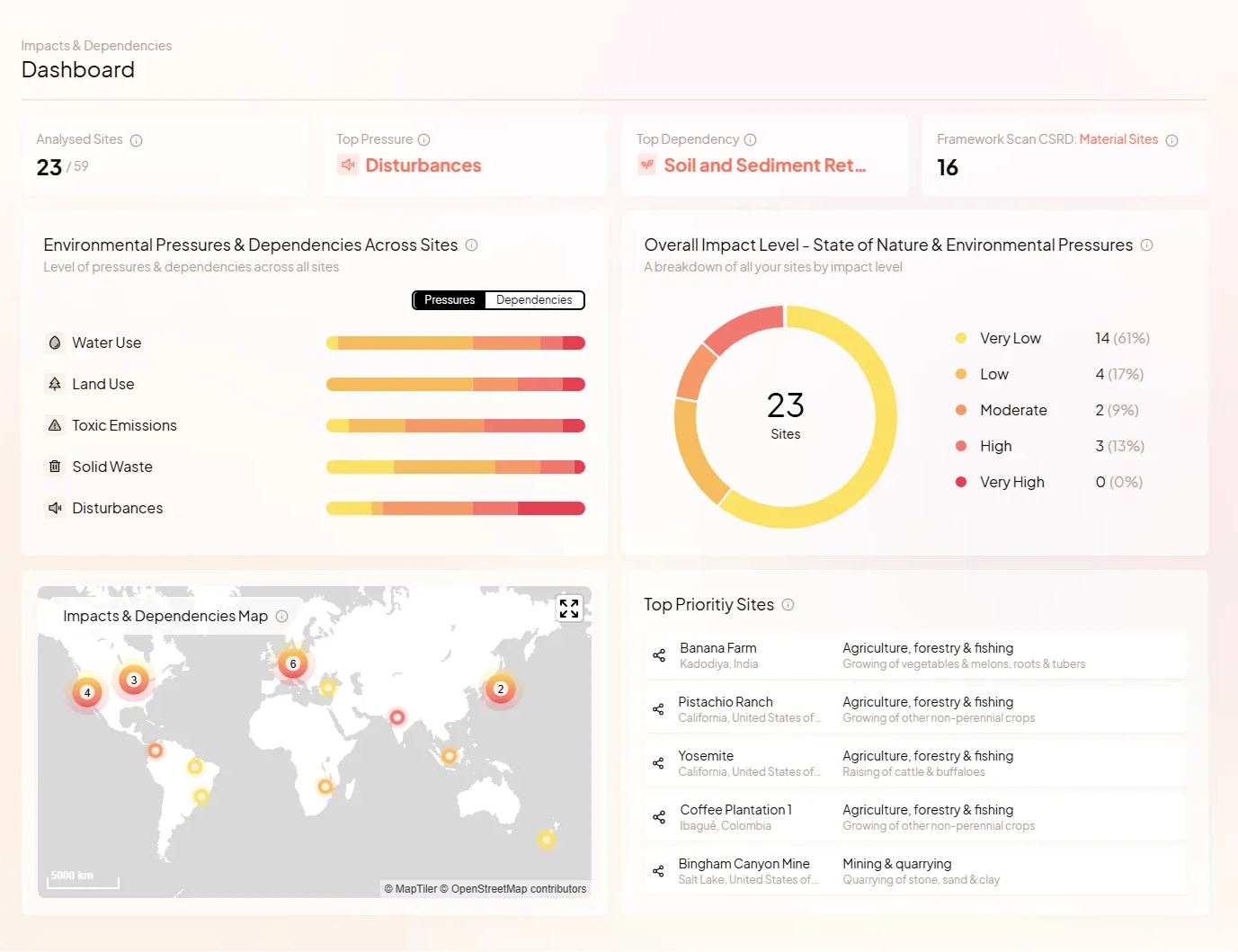
Environmental Pressures & Dependencies Across Sites
ENCORE provides activity-based estimates of Environmental Pressures and Dependencies ranging from Very Low (VL) to Very High (VH). The bar chart shows how the analysed sited are distributed across the different relevance levels for a selection of Environmental Pressures & Dependencies.
Overall Impact Level - State of Nature & Environmental Pressures
The Overall Impact Level summarizes your potential contribution to negative Nature Impacts by combining Environmental Pressure estimates with relevant pressure-sensitive State of Nature at each site. The Impact Levels for each site are aggregated into an Overall Impact Level, ranging from Very Low to Very High. The donut chart illustrates how the analysed sites are distributed across these Overall Impact Levels.
For more details on how Overall Impact Level is determined, see this article.
Impacts & Dependency Map
The Impacts & Dependency Map displays your sites and their Impact Level geographically. You can expand, navigate and zoom in to the map to get a sense where on the world you interact with nature. Clicking on a respective site navigates to the corresponding site view.
Top Priority Sites
Top Priority Sites lists the sites with the highest estimated Impact Levels.
Framework Scan CSRD
The CSRD Framework Scan identifies sites that are expected or confirmed to have material impacts on biodiversity and ecosystems. This assessment is essential for identifying material sites, as required under CSRD ESRS E4 Articles 16(a) and 17(a). Businesses must report on the proximity of material sites to biodiversity-sensitive areas, their negative impacts, and local mitigation actions.
- The materiality expectation is based on the ENCORE estimates for Environmental Pressures. If a site has material pressures, the site is expected have material impact on biodiversity and ecosystems.
- The following logic is applied to identify material pressures:
- Any Pressure estimated Very High
- Any Pressure estimated High
- The particularly relevant pressures Water Use, Non-GHG Air Pollution, Toxic Emissions, Nutrient Emissions are also estimated as material when estimated Moderate
- The automated activity-based materiality expectation can be overwritten at site level in cases where more accurate data or expert knowledge contradicts the automated assessment. This flexibility ensures that materiality assessments reflect the most accurate and site-specific conditions possible.
Impacts & Dependencies List View
The Impacts & Dependencies Site List provides a list of all sites, summarizing for each site the CSRD impact materiality as well as a selection on Environmental Pressures and Dependencies. You can navigate to the individual site view by selecting a row.
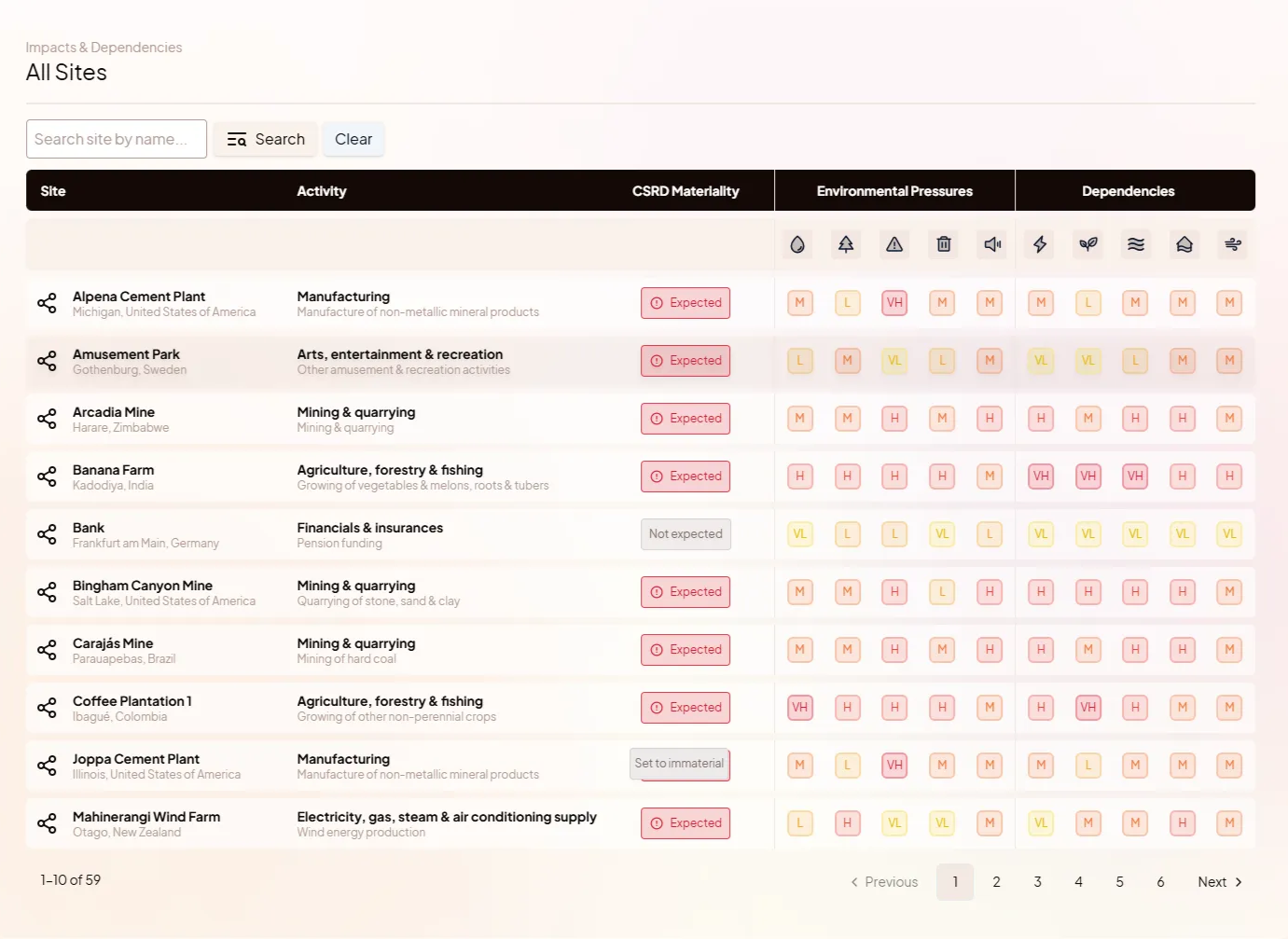
Impacts Site View
The Impacts Site View leads through the impact analysis providing information on the site’s Environmental Pressures, the CSRD Framework Scan and the Impact Levels. The following section will take you through each graphic in the view.
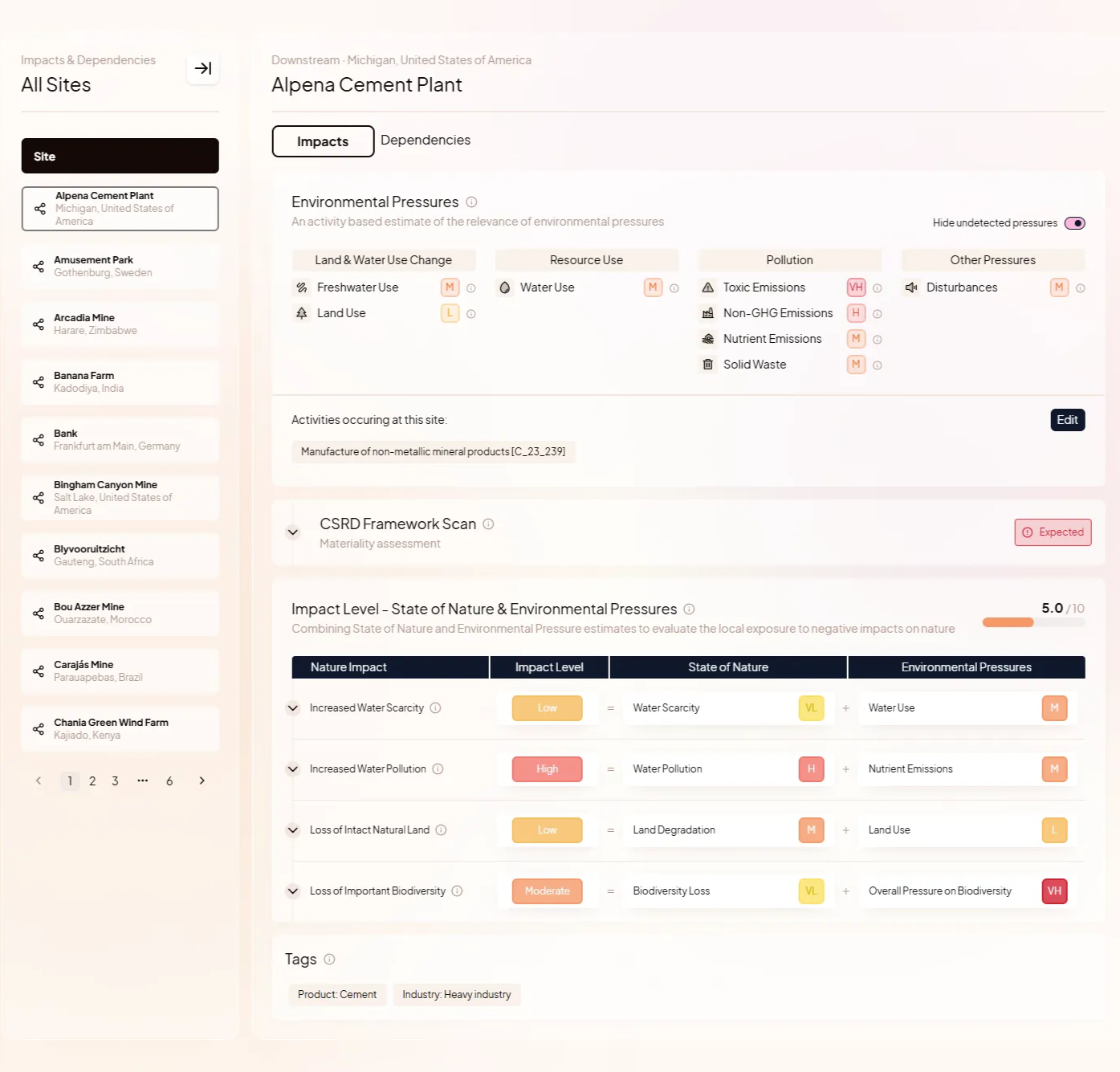
Environmental Pressures
Environmental Pressures refer to resource use, emissions, and other disturbances caused by economic activities. Based on the ENCORE database, Nala provides activity-based estimates for 12 different Environmental Pressures, categorized into Land & Water Use Change, Resource Use, Pollution, and Other Pressures (full list available here). The intensity of these pressures is rated from Very Low to Very High.
Hovering over the info buttons provides an explanation of the specific estimate, sourced from the ENCORE knowledge base.
If multiple activities are assigned to the same site, the highest level of each environmental pressure across all activities is displayed. For example, if a site includes both "Manufacture of basic chemicals" (with High Water Use) and "Head office activities" (with Low Water Use), the site’s water use is shown as High.
By default, the displayed pressures correspond to the activities occurring at the site. Disabling the Hide undetected Pressures toggle reveals additional pressures that ENCORE does not associate with the selected activities.
You can modify the economic activities at a site using the “Edit” option.
A note on Pressures vs Impacts
Please note that Pressures and Impacts are distinct but related concepts. Pressures are the direct effects of human activities on the environment, such as resource use, emissions, or disturbances. Impacts are the resulting changes in the state of nature. As such Pressures can be viewed as causes or leading indicators of eventual negative changes in the state of nature.
This distinction follows the Driver-Pressure-State-Impact-Response (DPSIR) framework, widely used in environmental regulations and reporting. The ENCORE knowledge base defines pressures as measurable resource use or emissions that trigger changes in ecosystems. Some frameworks, like the Taskforce on Nature-related Financial Disclosures (TNFD) and the Natural Capital Protocol, refer to pressures as Impact Drivers.
CSRD Framework Scan
The CSRD Framework Scan assesses whether a site is expected to have material impacts on biodiversity and ecosystems.
This assessment is essential for identifying material sites, as required under CSRD ESRS E4 Articles 16(a) and 17(a). Businesses must report on the proximity of material sites to biodiversity-sensitive areas, their negative impacts, and local mitigation actions.
The materiality expectation is determined based on ENCORE estimates for Environmental Pressures. A site is expected to have a material impact on biodiversity and ecosystems if it meets the following criteria:
- Any pressure estimated as Very High
- Any pressure estimated as High
- The particularly relevant pressures Water Use, Non-GHG Air Pollution, Toxic Emissions, and Nutrient Emissions are also considered material if estimated as Moderate.
Overwriting the automated materiality assessment
The default activity-based materiality expectation can be adjusted at the site level when more accurate data or expert knowledge contradicts the automated assessment. This flexibility ensures materiality assessments reflect the most precise and site-specific conditions.
To override the materiality assessment, click Edit, select the appropriate materiality, and provide a justification.
Impact Level - State of Nature & Environmental Pressures
The Impact Level estimates a site's potential contribution to negative nature impacts by combining Environmental Pressure estimates with pressure-sensitive State of Nature data at the site. Each of the four Nature Impacts is assigned an Impact Level from Very Low to Very High, based on relevant pressure estimate and the State of Nature Concern Level.
Aligned with the DPSIR framework (see above), this assessment approximates potential negative impacts by considering both environmental pressures and corresponding nature data, rather than pressures alone. As such, Impact Levels can also inform your evaluations of the automated CSRD materiality expectation.
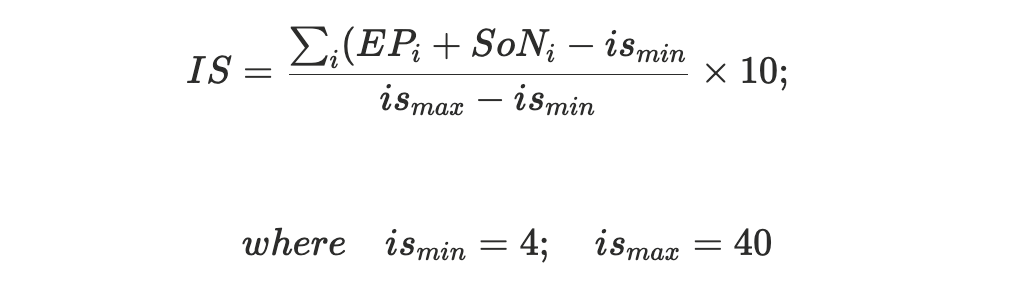
The individual Impact Levels are quantified into an Impact Score on a scale from 0 to 10.
How is Impact Score calculated?
- For each site, an Impact Score is calculated based on the four Nature Impacts. For this, the Environmental Pressures (EP) and State of Nature Concern Levels (SoN) are treated numerically (VL= 1, L=2, M=3, H=4, VH=5) and summed across the four covered Nature Impacts (Increased Water Scarcity, Increased Water Pollution, Loss of Natural Land, Loss of important Biodiversity).
- The Impact Score is then scaled to a 0-10 range using the following formula:
 Overall Pressure on Biodiversity
The Overall Pressure on Biodiversity estimates the general effect of a site’s Environmental Pressures on local biodiversity.
The ENCORE knowledge base provides estimates on how individual pressures affect different ecosystem components through mechanisms of change. Two covered ecosystem components are directly related to biodiversity: Species and Structural and Biotic Integrity. The Overall Pressure on Biodiversity is determined by assessing extent to which the site’s Environmental Pressures affect these two biodiversity-related ecosystem components based on ENCORE’s pressure-to-components linkages. The resulting estimate is expressed on a scale from Very Low to Very High.
Dependencies Site View
The Dependency Site View leads through the dependency analysis providing information on the site’s Dependencies on Ecosystem Services and the Dependency Levels. The following section will take you through the individual elements of the Dependencies Site View.
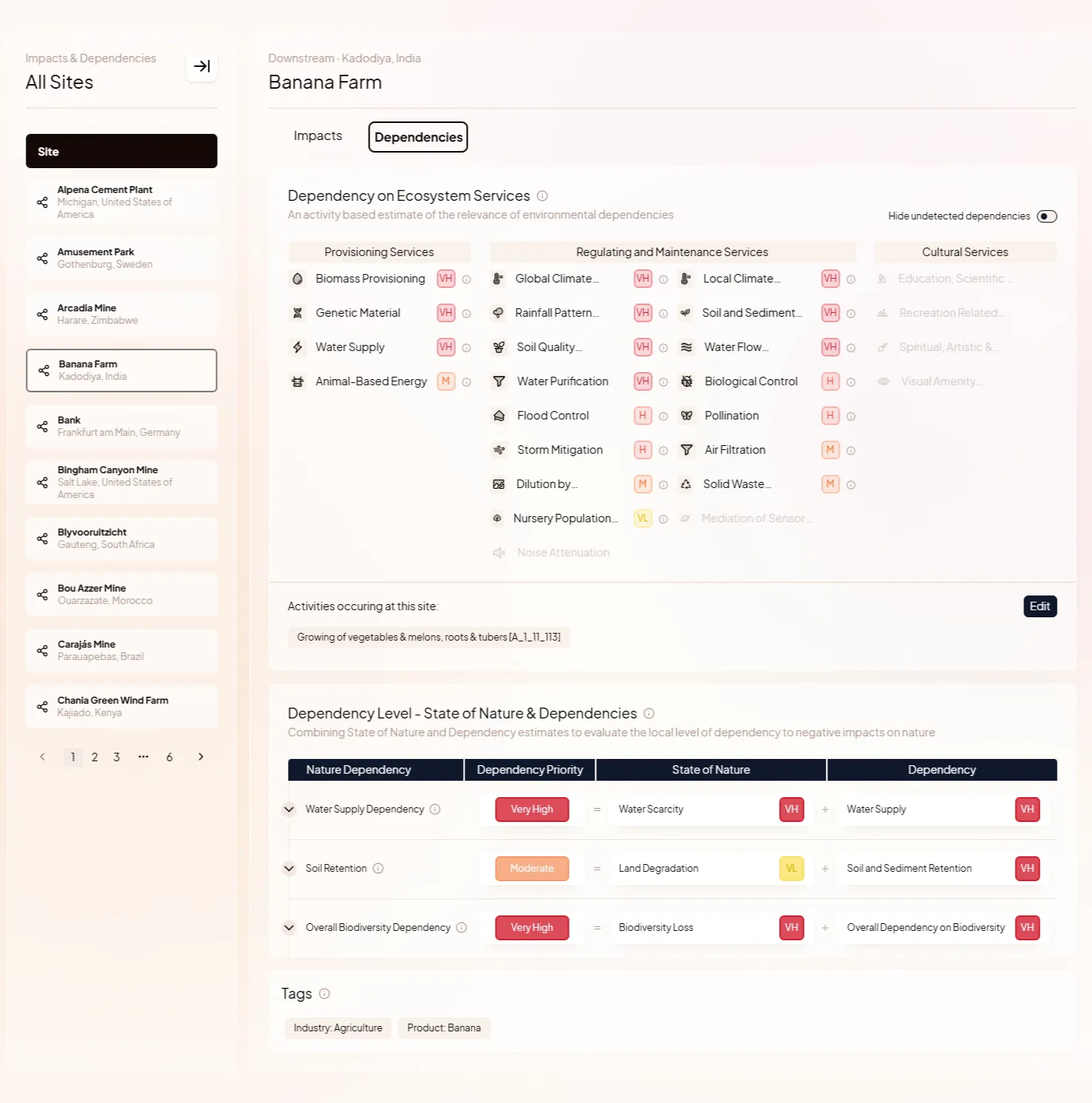
Dependencies on Ecosystem Services
Dependencies refer to the reliance of economic activities on the Ecosystem Services that nature provides. Based on the ENCORE database, Nala provides activity-based estimates for 25 different Dependencies on Ecosystem Services, categorized into Provisioning Services, Regulating and Maintenance Services and Cultural Services (full list available here). The relevance of these dependencies is rated from Very Low to Very High.
Hovering over the info buttons provides an explanation of the specific estimate, sourced from the ENCORE knowledge base.
If multiple activities are assigned to the same site, the highest level of each Dependency across all activities is displayed. For example, if a site includes both "Manufacture of basic chemicals" (with High Water Supply) and "Head office activities" (with Low Water Supply), the site’s dependency on Water Supply is shown as High.
By default, the displayed dependencies correspond to the activities occurring at the site. Disabling the “Hide undetected dependencies” toggle reveals additional dependencies that ENCORE does not associate with the selected activities.
You can modify the economic activities at a site using the “Edit” option.
Dependencies vs Risks
Dependencies and nature-related risks are distinct but interconnected concepts. Dependencies on Ecosystem Services describe how economic activities rely on the services nature provides. When nature is degraded and can no longer supply these services effectively, dependencies can translate into nature-related risks.
Such dependency-driven physical nature risks can impact businesses by:
- Increasing the cost of natural inputs (e.g., water, timber, crops, minerals)
- Disrupting production-relevant ecosystem services (e.g., water availability, pollination, soil fertility)
- Reducing natural protection against hazards (e.g., floods, droughts, extreme temperatures)
The identification and quantification of dependency-driven nature risks will be addressed in Nala’s upcoming Risk Module.
Dependency Level - State of Nature & Environmental Pressures
The Dependency Level estimates a site's potential exposure to the loss of ecosystem services by combining Dependency estimates with State of Nature data on relevant nature components.
Each of the three covered Dependencies is assigned a Dependency Level ranging from Very Low to Very High, based on the site's dependency estimate and the State of Nature Concern Level.
Biodiversity Loss
To assess Overall Biodiversity Dependency, we use an approximate metric of Biodiversity Loss:
- To estimate the level of Biodiversity Loss experienced by the local ecosystem, we take the minimum value of the Mean Species Abundance (MSA) and Biodiversity Intactness Index (BII) indicators. This minimum value determines the concern level according to the following thresholds:
- Min (BSA, MSA) >80% = Very Low Biodiversity Loss
- Min (BSA, MSA) = 60%-80% = Low Biodiversity Loss
- Min (BSA, MSA) = 40%-60 = Moderate Biodiversity Loss
- Min (BSA, MSA) = 20%-40 = High Biodiversity Loss
- Min (BSA, MSA) ≤20% = Very High Biodiversity Loss
- In a future update, the Biodiversity Loss metric will be refined to reflect changes in biodiversity intactness over time, enabling a more dynamic and historical perspective on ecosystem degradation.
Overall Dependency on Biodiversity
The Overall Dependency on Biodiversity estimates a site’s general reliance Ecosystem Services that depend on intact biodiversity.
The ENCORE knowledge base provides estimates on how individual ecosystem services depend on different ecosystem components. Two covered ecosystem components are directly related to biodiversity: Species and Structural and Biotic Integrity. The Overall Dependency on Biodiversity is determined by evaluating extent to which the site’s activities depend on these these two biodiversity-related ecosystem components based on ENCORE’s ecosystem service-to-components linkages. The resulting estimate is expressed on a scale from Very Low to Very High.
Data Attribution ENCORE
The impacts & dependency module includes unmodified data sourced from ENCORE by ENCORE Partners (Global Canopy, UNEP FI, and UNEP-WCMC), licensed under the Creative Commons Attribution-ShareAlike 4.0 International License (CC BY-SA 4.0).
Original source: ENCORE Partners (Global Canopy, UNEP FI, and UNEP-WCMC) (2025). ENCORE: Exploring Natural Capital Opportunities, Risks and Exposure. [On-line], [07.2025], Cambridge, UK: the ENCORE Partners. Available at: https://encorenature.org. DOI: https://doi.org/10.34892/dz3x-y059.